Successful options trading is not about being correct most the time, but about being a good repair mechanic. When things go wrong, as they often do, you need the proper tools and techniques to get your strategy back on the profit track. Here we demonstrate some basic repair strategies aimed at increasing profit potential on a long call position that has experienced a quick unrealized loss.
Defense Is Just as Important as Offense
Repair strategies are an integral part of any trading plan. I always review a well thought-out set of "what-if" scenarios before putting any money at risk. Too often, though, beginner options traders give little thought to potential follow-up adjustments or possible repair strategies before establishing positions. Having a great strategy is important, but making a profit is highly correlated with how well losing trades are managed. "Play good defense" is my options-trading mantra.
Fixing a Long Call
Many traders will buy a simple call or put only to find that they were wrong about the expected movement of the underlying stock. An out-of-the-moneylong call position, for example, would experience immediate unrealized losses should the stock drop. What should the trader do in this situation?
Repair strategies are an integral part of any trading plan. I always review a well thought-out set of "what-if" scenarios before putting any money at risk. Too often, though, beginner options traders give little thought to potential follow-up adjustments or possible repair strategies before establishing positions. Having a great strategy is important, but making a profit is highly correlated with how well losing trades are managed. "Play good defense" is my options-trading mantra.
Fixing a Long Call
Many traders will buy a simple call or put only to find that they were wrong about the expected movement of the underlying stock. An out-of-the-moneylong call position, for example, would experience immediate unrealized losses should the stock drop. What should the trader do in this situation?
Let's examine a simple long call example, which demonstrates a concept that you can apply also to a long put. Suppose it is currently the middle of February and we believe that IBM, which at 93.30, is poised to make a move aboveresistance (the upper green line in Figure 1) at about 95. We have good reason to jump in early with the purchase of a July 95 near-the-money call. With about 150 calendar days left until expiration, there is plenty of time for the move to occur.
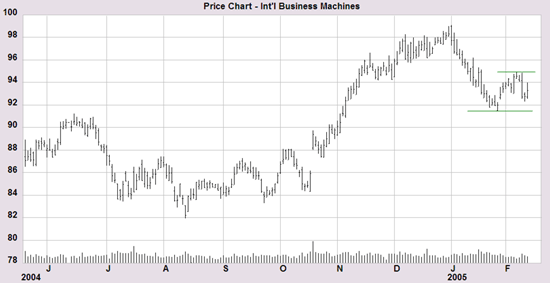 |
| Figure 1 – IBM daily price chart showing medium support/resistance levels. |
But suppose, not long after we enter the position, IBM gets a downgrade and drops suddenly, perhaps even below medium-term support at 91.60 (the lower green line in Figure 1) to about 89.34. The price of the July 95 call would now be worth about $1.25 (assuming some time-value decay), down from $3, rendering an unrealized loss of $175 per option. Figure 2 presents the profit/loss profile of this trade.
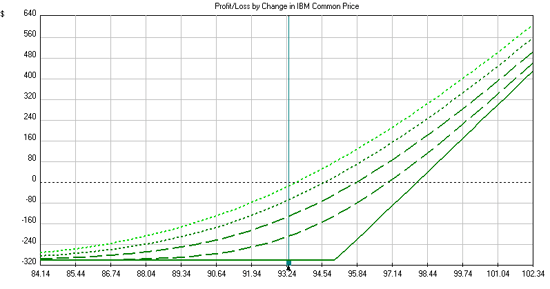 |
| Figure 2 – IBM July 95 long call profit/loss. |
With so much time remaining until expiration, however, it's still possible that IBM may reach and surpass the strike price of 95 by Jul 16, but waiting could add additional losses and present additional opportunity costs, which result from our forgoing any other trade with profit potential during the same period.
| Initial IBMPrice | July 95 Call Purchase Price | Lower IBM Price | Lower July 95 Call Price | July 90 Call Price |
| 93.30 | $3.00 | 89.30 | $1.25 | $2.75 |
| Table 1 – Options prices before and after IBM price change. | ||||
One way to address unrealized loss is to average down by purchasing more options, but this only increases risk should IBM keep falling or never return to the price of 95. Actually, the breakeven on the original July 95 call, which was purchased for $3, is 98. This means that the stock would have to rise by nearly 10% to get to the breakeven point. Averaging down by purchasing a second option with a lower strike price, such as the July 90 call, lowers the breakeven point, but adds considerable additional risk, especially since the price has broken below a key support level of 91.60 (indicated in Figure 1).
One simple method to lower the breakeven point and increase the probability of making a profit without increasing risk too much is to roll the position downinto a bull call spread. This is a strategy presented by options educator, Larry McMillan, in his book, "Options as a Strategic Investment", a must-have standard reference on options trading.
To implement this method we would place an order to sell two of the July 95 calls at the new price of $1.25, which amounts to going shortthe July 95 call option since we are long one option already (selling two when we are long one, leaves us short one). At the same time, we would buy a July 90 call, selling for about 2.90. Table 2 presents the price details:
To implement this method we would place an order to sell two of the July 95 calls at the new price of $1.25, which amounts to going shortthe July 95 call option since we are long one option already (selling two when we are long one, leaves us short one). At the same time, we would buy a July 90 call, selling for about 2.90. Table 2 presents the price details:
| Transactions | Debits/Credits | Cumulative Net Debits/Credits |
| Buy July 95 call | -$300 | -$300 |
| Sell 2 July 95 calls | +$250 | -$50 |
| Buy 1 July 90 call | -$275 | -$325 |
| Table 2 – Transaction details of rolling down into a bull call spread | ||
The net result of this adjustment into a bull call spread is that our total risk has increased only slightly, from $300 to $325 (not counting commissions). But our breakeven point has been lowered considerably from 98 to 93.25, a drop of 4.75%.
Suppose now that IBM manages to trade higher, back to the starting point of 93.30. Our bull call spread would now be just above breakeven, with a potential profit as high as 95, although limited to just $175 per option. We have, therefore, lowered our breakeven point without adding much additional risk, which makes good sense.
Alternative Repair Approach
Another repair attempt (which can perhaps be combined with the one above) is to roll down into a butterfly spread when IBM falls to 90. With this strategy we sell two July 90 calls, which would be going for about $4 each, and keep the July 95 long call, and then buy a July 85 call for about $7.30 (assuming a little bit of time-value decay in these numbers).
Alternative Repair Approach
Another repair attempt (which can perhaps be combined with the one above) is to roll down into a butterfly spread when IBM falls to 90. With this strategy we sell two July 90 calls, which would be going for about $4 each, and keep the July 95 long call, and then buy a July 85 call for about $7.30 (assuming a little bit of time-value decay in these numbers).
| Transactions | Debits/Credits | Cumulative Net Debits/Credits |
| Buy July 95 Call | -$300 | -$300 |
| Sell 2 July 90 Calls | +$800 | +$500 |
| Buy 1 July 85 Call | -$730 | -$230 |
| Table 3 – Transaction details for roll to a butterfly spread. | ||
The total risk actually decreases on the downside since the total debits fall to $230, but there is some limited upside risk should IBM move back above 92.65 (breakeven). If IBM goes nowhere, however, the trade actually produces a nice profit, occurring between 87.30 and 92.65. The profit/loss table below presents our different scenarios for this repair strategy:
| IBM Price At Expiration | Profit/Loss |
| 85.00 | -$225 |
| 87.30 | Breakeven |
| 90.00 | +$264 |
| 92.65 | Breakeven |
| 95.00 | -$235 |
| 100.0 | -$235 |
| Table 3 – Profit/loss details for butterfly spread repair strategy. | |
Meanwhile, maximum potential losses are $235 (upside) and $225 (downside). Maximum potential profit is at 90 with $264, and profit decreases marginally as you move toward the upper and lower breakeven points, as seen in Figure 3.
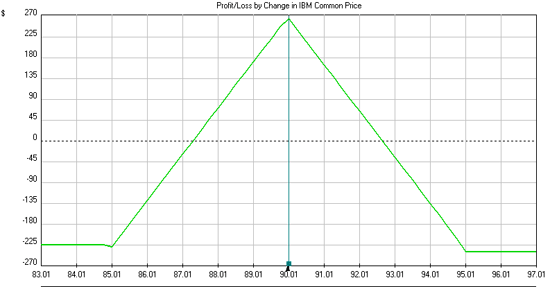 |
| Figure 3 – Butterfly Profit/Loss Profile |
Combining the Repair Strategies
Since this is a butterfly spread, maximum profit by definition is at the strike of the two short calls (July 90 calls), but movement away from this point eventually leads to losses. Therefore, the best overall approach might be to mix our two repair strategies in a multi-lot repair approach. This combination can preserve the best odds of producing a profit from a potential loser: the bull call-spread repair has a profit from 93.25 up to 95. And, there are ways to adjust a butterfly spread given moves of the underlying (a topic that would require a separate article).
Since this is a butterfly spread, maximum profit by definition is at the strike of the two short calls (July 90 calls), but movement away from this point eventually leads to losses. Therefore, the best overall approach might be to mix our two repair strategies in a multi-lot repair approach. This combination can preserve the best odds of producing a profit from a potential loser: the bull call-spread repair has a profit from 93.25 up to 95. And, there are ways to adjust a butterfly spread given moves of the underlying (a topic that would require a separate article).
The Bottom Line
We've looked at two ways (which might best be combined) to adjust a long call position gone awry. The first involves rolling down into a bull call spread, which significantly lowers overhead breakeven while preserving reasonable profit potential (albeit this potential is limited, not unlimited as in the original position). The cost poses only a tiny increase in risk. The second approach is to roll into a butterfly spread by keeping our original July call, selling two at-the-money call options and buying an in-the-money call option. Whether used alone or in tandem, these repair strategies offer some flexibility in your trading plans.
We've looked at two ways (which might best be combined) to adjust a long call position gone awry. The first involves rolling down into a bull call spread, which significantly lowers overhead breakeven while preserving reasonable profit potential (albeit this potential is limited, not unlimited as in the original position). The cost poses only a tiny increase in risk. The second approach is to roll into a butterfly spread by keeping our original July call, selling two at-the-money call options and buying an in-the-money call option. Whether used alone or in tandem, these repair strategies offer some flexibility in your trading plans.
There will always be losses in options trading, so each trade must be evaluated in light of changing market conditions, risk tolerance and desired objectives. That said, by properly managing the potential losers with smart repair strategies, you stand a better chance of winning at the options game in the long run.